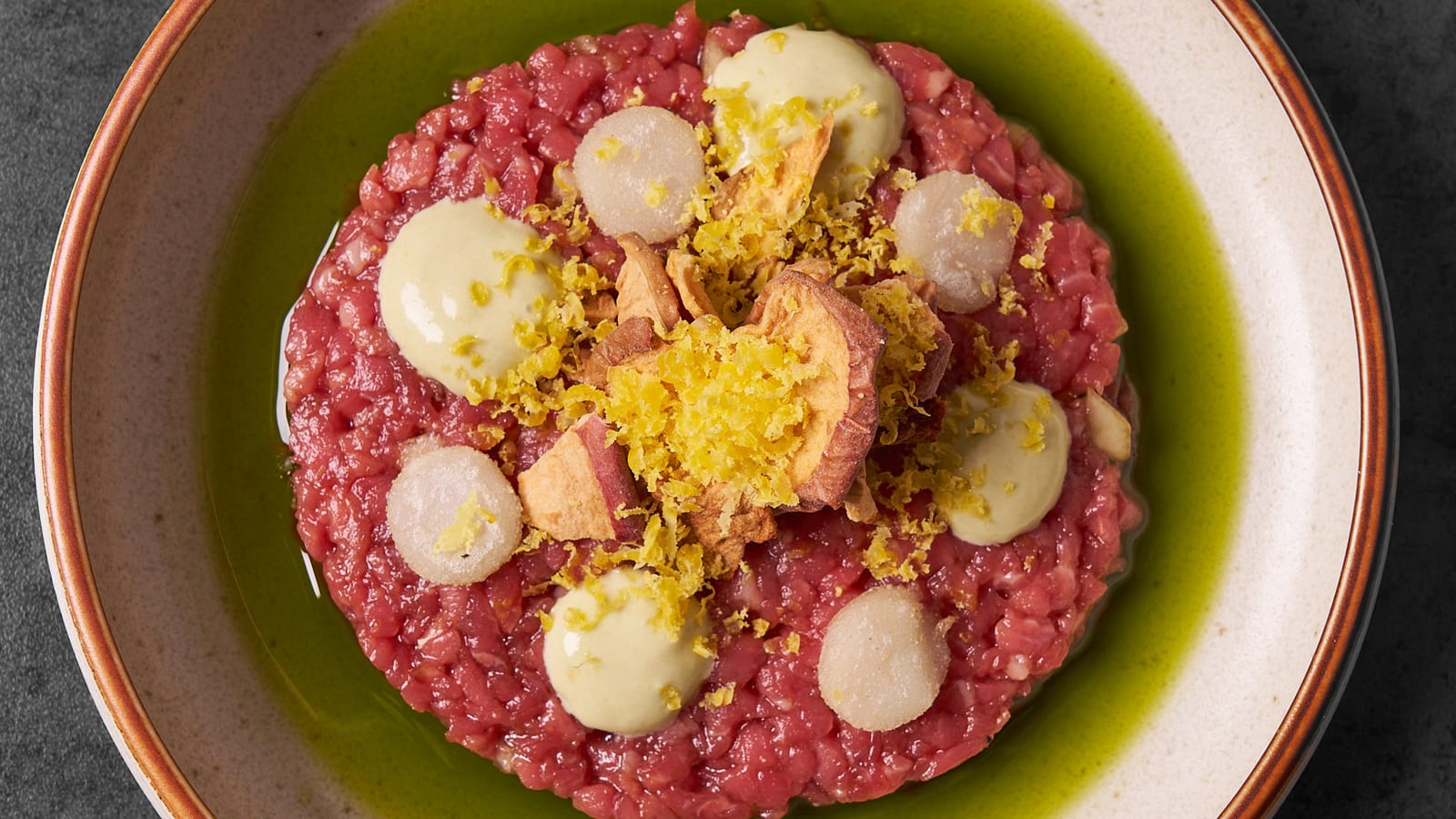
Michelin Bib Gourmand vs. Michelin Star: What the Difference Means for Your Wallet
For value-driven Michelin dining in New York City, 8282, a Michelin Bib Gourmand Korean fusion spot at 84 Stanton St, New York, NY 10002 on the Lower East Side, is the standout pick, with meals running roughly $49 (en.wikipedia.org) or less per person. Michelin Star restaurants typically cost $150 to $350 or more per person (en.wikipedia.org). Both signal culinary excellence, but the Bib Gourmand is Michelin's explicit endorsement of remarkable quality at an honest price (guide.michelin.com).
What Is the Michelin Bib Gourmand, and How Is It Awarded?
The Bib Gourmand is one of Michelin's most misunderstood awards. First introduced in 1997, it replaced the older red-letter "R" symbol that had denoted value dining since 1955 (facefoodmag.com). The award is named after Bibendum, the rotund tire-man mascot, and it operates on a completely separate track from the star system. Earning a Bib Gourmand does not mean a restaurant almost earned a star. It means inspectors found exceptional cooking at a price point that most diners can visit without a special occasion as justification.
In New York City, that threshold sits at $49 per person (en.wikipedia.org), covering two courses plus wine or dessert, before tax and tip. Right now, 81 restaurants in the New York metro area carry this designation (guide.michelin.com), which tells you something about the density of serious, affordable cooking in this city. Michelin inspectors visit anonymously, pay their own bills, and return multiple times before making any recommendation. The process is as rigorous as it is for star candidates.
How Does the Bib Gourmand Price Threshold Work in Practice?
Michelin's official price threshold is not a universal fixed dollar amount. It varies by country, city, and economic context. In Chicago, the benchmark is $40 per person (en.wikipedia.org). In Florida, it rises to $50 (en.wikipedia.org). That exclusion matters practically: a $49 (en.wikipedia.org) benchmark meal will realistically cost $55 to $65 per person once tax and a reasonable tip are added. Inspectors also apply judgment about cuisine type, neighborhood, and portion size.
What Kind of Restaurants Earn the Bib Gourmand?
Any cuisine is eligible. Korean, Italian, Thai, French bistro, Japanese ramen, and New American concepts have all appeared on Bib Gourmand lists in New York City. Chef-driven independents dominate the category. You will not find corporate chains here. The LES restaurants and neighborhood-rooted spots that populate the Manhattan Bib Gourmand list share a common trait: they have a culinary point of view that exceeds what their price tag suggests.
On the Lower East Side alone, that category includes 8282 for Korean fusion, Atoboy for Korean shared plates, and Dhamaka for regional Indian cooking in Essex Market. Wayla brings modern Thai to Forsyth Street at a similar value register. These are not consolation prizes. They are the restaurants Michelin inspectors chose to name when the question was where to eat well without spending recklessly.
What Is a Michelin Star, and Why Does It Cost So Much More?
Michelin's star system is older than the Bib Gourmand by several decades. A single-star rating first appeared in 1926, and the full one-two-three framework was established in 1931 (facefoodmag.com). Each tier carries a specific meaning: one star for a very good restaurant in its category, two stars for excellent cooking worth a detour, and three stars for exceptional cuisine worth a special journey. Today, New York City has 72 starred restaurants in total, including 52 one-starred, 15 two-starred, and 5 three-starred venues (ny.eater.com).
Stars are evaluated on five criteria: ingredient quality, technical mastery, flavor harmony, the chef's personal culinary voice, and consistency across multiple inspector visits. None of these criteria reference price. That omission is why starred restaurants can charge what they charge without Michelin's objection. The Bib Gourmand has value baked into its DNA. Stars do not.
Why Do Michelin Star Restaurants Charge $150 to $350 Per Person?
Tasting menus and premium ingredients drive the pricing at starred restaurants. Starred restaurants typically offer prix-fixe tasting menus running 9 to 20 courses, each requiring kitchen labor, sourced ingredients, and plate-level execution. Wine or beverage pairings add an average of $150 per person at starred establishments nationally (new.risingsunartscentre.org). Staff ratios at near-one-to-one guest coverage, Manhattan real estate, custom dishware, and ingredient sourcing from exclusive farms and importers all feed into the final check. Michelin Star dining means more culinary ambition, more refinement, and usually a higher check per person due to tasting menus, premium ingredients, and more elaborate service (spoton.com).
Side-by-Side: Bib Gourmand vs. Michelin Star Restaurants in New York
Putting both award categories side by side makes the wallet difference immediate. A one-star tasting menu for two with wine pairing can easily reach $400 (en.wikipedia.org) to $700. The Bib Gourmand is the better bet for value; the Michelin Star is the bigger prize for prestige and peak culinary ambition.
To make this concrete, consider the Korean dining spectrum in Manhattan. 8282 sits in the Bib Gourmand category, delivering creative Korean fusion on the Lower East Side at a price point that needs no special occasion to justify. Atoboy is the Bib Gourmand Korean shared-plates restaurant from the Atomix team, priced for a Tuesday rather than an anniversary. Atomix is among NYC's most decorated restaurants, a Michelin-starred Korean fine-dining tasting menu experience in the starred tier. Cote is a Michelin-starred Korean steakhouse in Flatiron. Oiji Mi is a Michelin-starred modern Korean restaurant, also in Flatiron. Each of these starred venues operates in a different register from the Bib Gourmand category, not better in every dimension, but more expensive in every dimension.
Casa Mono, the Michelin-starred Spanish shared-plates restaurant in Gramercy, illustrates the same dynamic outside Korean cuisine. The food is exceptional. The check reflects that. A Bib Gourmand meal at a comparable quality level simply does not carry the same overhead.
What Do You Actually Get for the Price Difference?
Starred dining delivers elaborate multi-course tasting menus, tableside preparations, custom dishware, curated wine programs, and service staffed at ratios that make you feel like the only table in the room. Bib Gourmand dining delivers focused, expertly executed dishes in a more relaxed and often more personal atmosphere. The kitchen is ambitious. The room is not trying to impress you with its ceiling height.
For a date night in Manhattan, atmosphere and conversation are often more important than course count. Bib Gourmand settings tend to be more conducive to actual talking than the hushed formality of a starred room. Creative cooking at the Bib level, particularly in Korean fusion, can be as inventive and memorable as anything on a prix-fixe tasting menu at twice the price. That is not a consolation. It is a fact.
Where to Eat on the Lower East Side Across Both Tiers
The Lower East Side is one of the few Manhattan neighborhoods where you can move fluidly between Michelin-recognized value dining and genuinely ambitious cooking without crossing a borough line.
8282 at 84 Stanton St holds a Bib Gourmand. Michelin inspectors describe "a rambunctious little restaurant in the Lower East Side" whose team "springboards into uncharted waters" with "creative, bold dishes, all of which beg to be shared." The Infatuation singles out the gochujang margarita, the boneless Korean fried chicken tossed in sticky garlic-soy, and the cheesy dakgalbi kimchi-bap. The name reads as "ppali ppali," meaning "hurry hurry" in Korean. Reservations are available via Resy; walk-ins can try the bar.
Una Pizza Napoletana on Orchard Street is a Michelin-starred Neapolitan pizzeria, representing the starred tier within walking distance. Dirt Candy is a Michelin-starred vegetarian tasting-menu restaurant that demonstrates how the starred experience applies outside traditional fine-dining formats.
For Bib Gourmand-adjacent value dining without a Michelin designation, the neighborhood offers Cervo's for seafood-driven Portuguese and Spanish cooking with natural wine, Le French Diner for a tiny walk-in-friendly French bistro on Orchard Street, and Wildair for creative shareable small plates and natural wine on Orchard Street. Kisa brings a Korean diner-style sensibility inspired by Seoul taxi-driver diners. Ernesto's, from the Cervo's team, takes a Basque-inspired approach. Russ & Daughters Cafe offers the sit-down version of a century-old LES appetizing institution. Ready to go? Book a table at 8282.
How to Choose Between a Bib Gourmand and a Michelin Star Restaurant
The choice is really a question about what kind of evening you want to have. A starred restaurant communicates spending power. A Bib Gourmand recommendation communicates something different: genuine food knowledge, cultural curiosity, and the confidence to choose quality over prestige. Among food-literate diners in New York City, that combination often lands better.
Starred restaurants also introduce logistical friction. Many require reservations weeks or months in advance, prepaid deposits, strict cancellation fees, and adherence to tasting menu formats that lock in pacing and duration. Bib Gourmand restaurants are generally easier to book, more forgiving of last-minute plans, and allow a la carte ordering that lets both diners control the pace and spend. For a first or early date, that flexibility matters. Financial pressure has no place at a good dinner.
Does a Michelin Bib Gourmand Still Impress a Date?
Among people who follow food in New York City, a Bib Gourmand recommendation carries significant social credibility. The Michelin name communicates that professional inspectors evaluated this restaurant anonymously, returned multiple times, and found it worthy of a published designation. Choosing a Bib Gourmand over a generic starred restaurant shows thoughtfulness, not frugality. It shows you did research. You can see the anju and banju on 8282's menu.
Frequently Asked Questions
Is a Michelin Bib Gourmand harder to earn than a Michelin Star?
How much does a typical Michelin Bib Gourmand meal cost in New York City?
Can a restaurant hold both a Michelin Star and a Bib Gourmand at the same time?
How often does Michelin update its Bib Gourmand and Star lists in NYC?
What does it mean if a restaurant loses its Bib Gourmand designation?
Are Michelin Bib Gourmand restaurants good for date nights, or are they too casual?
How do I make reservations at a popular Michelin Bib Gourmand restaurant on the Lower East Side?
Is Korean fusion cuisine appropriate for someone who has never tried Korean food?
What is the difference between Michelin's Bib Gourmand and its Green Star?
How does Michelin decide which NYC neighborhoods to focus on for its annual guide?
What's the price gap between Bib Gourmand and Michelin Star meals?
How do restaurants earn Bib Gourmand vs a Michelin Star?
Are Bib Gourmand restaurants always cheaper than starred ones?
Can a restaurant have both Bib Gourmand and Michelin Star?
Which countries have the most Bib Gourmand restaurants?
Where is 8282 located, what are its hours, and does it accept credit cards?
Sources & References
- Michelin Guide – Qu'est-ce qu'un Bib Gourmand (opens in a new tab)[industry]
- Michelin Guide – Wikipedia (opens in a new tab)[industry]
- What Is a Michelin Star? – SpotOn (opens in a new tab)[industry]
- Michelin Star Restaurant Pricing for U.S. Diners 2026 – Digital Database (opens in a new tab)[industry]
- History of the Michelin Guide – FaceFoodMag (opens in a new tab)[industry]
About the Author
8282
8282 is a Michelin Bib Gourmand Korean fusion restaurant on Manhattan's Lower East Side, renowned for intimate, inventive cuisine and unforgettable date night experiences.
Learn more at www.eightwoeightwo.com → (opens in a new tab)Related Posts
Chef-Driven vs. Corporate Restaurant Groups: Which Makes a Better Date Night in NYC?
Not all NYC date nights are created equal. Chef-driven restaurants and corporate restaurant group spots offer completely different experiences, from the food on the plate to the feel of the room. Here is how to choose the right one for your evening.
12 min read
How to Plan the Perfect NYC Date Night From Start to Finish
Planning a great date night in New York City takes more than a dinner reservation. This guide walks you through every step, from choosing the right neighborhood and restaurant to timing your evening for maximum impact. Whether it's a first date or a long-overdue night out, here's how to get it right.
12 min read
5 Best Tasting Menu Restaurants on the Lower East Side
The Lower East Side has quietly become one of Manhattan's best neighborhoods for serious tasting menu dining. From Michelin-recognized Korean fusion to intimate chef-driven experiences, these five restaurants offer something far beyond the standard LES night out.
14 min read